
Top Dog Studios
New York, NY
Signal, extracted.
Top Dog Studios LLC is a New York quantitative firm with two lines of work: Palladium Data, high-density pre-training corpora for language models, and systematic market-making on regulated U.S. event-contract venues.
Palladium Data
Train smarter, not bigger.
Physics-filtered pre-training data that delivers 17% lower loss than standard web corpora at identical compute budget. Information theory separates signal from noise — so your model trains faster on less data.
The problem
Most LLM training corpora are built by scraping the internet and applying heuristic filters. The result: billions of tokens of SEO spam, boilerplate, duplicated content, and low-information text that your model must process before it learns anything useful.
Palladium Data takes a different approach. We treat data filtration as a physics problem — using information theory to quantify the information density of every document. The result is a corpus where every token carries measurably more signal.
Results
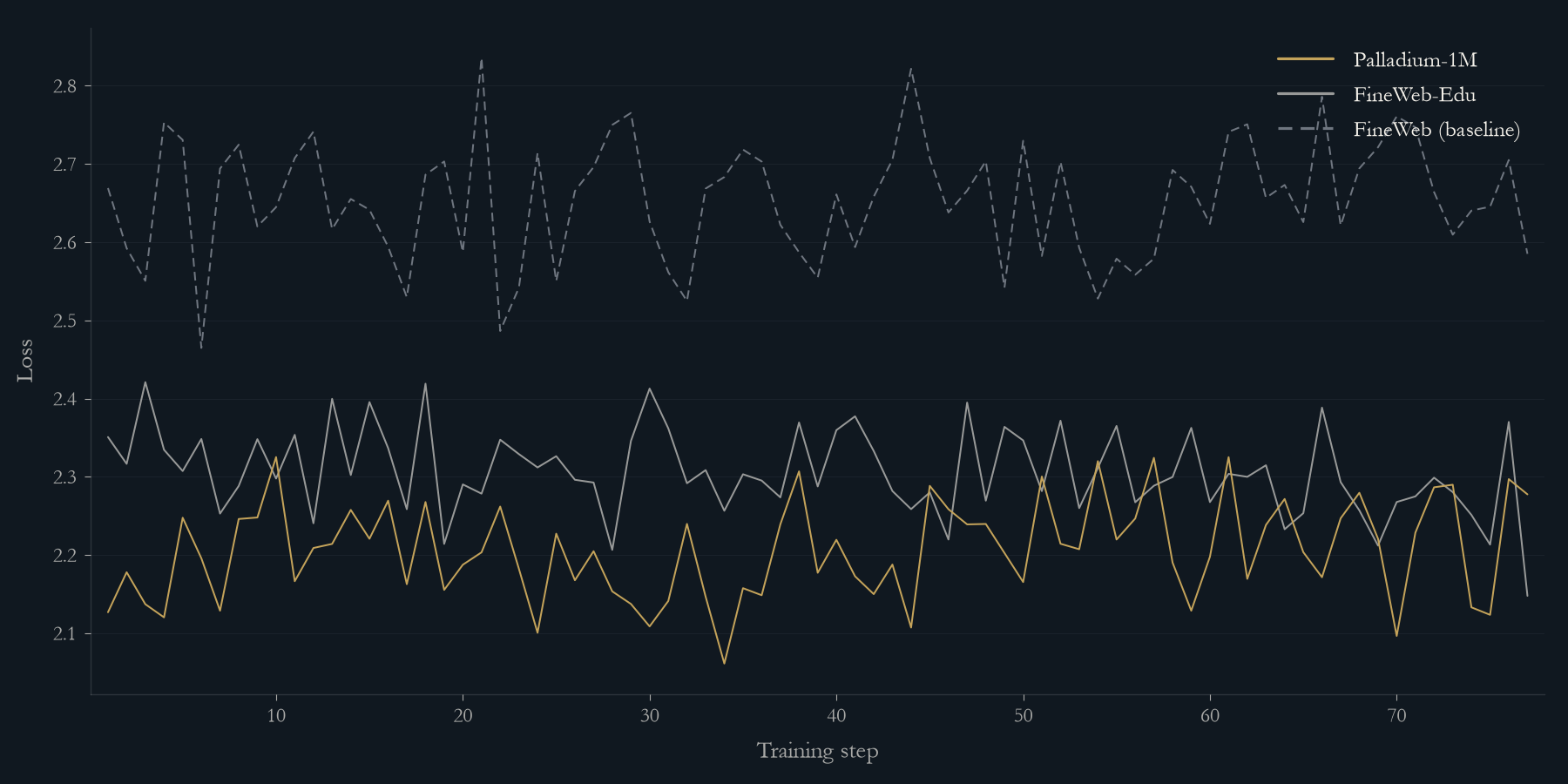
We trained Qwen 2.5 (1.5B) on three datasets under identical conditions: same base model, same hyperparameters, same token budget (5M tokens), same hardware (NVIDIA A5000). Only the training data changes.
Training loss
| Dataset | Mean training loss | Time (hrs) | Tokens/sec |
|---|---|---|---|
| Palladium-1M | 2.206 | 0.62 | 2,244 |
| FineWeb-Edu | 2.306 | 0.64 | 2,184 |
| FineWeb (baseline) | 2.654 | 0.64 | 2,173 |
Table 1. Training results on Qwen 2.5 (1.5B) with 5M token budget. Loss is the mean over the 77 logged training steps. Palladium achieves 17% lower mean loss than FineWeb and 4.3% lower than FineWeb-Edu under identical compute constraints.
Downstream evaluation
We evaluated all models on five standard benchmarks. At the 5M token scale, downstream performance remains stable across all datasets — no degradation from the curated corpus. This is expected: continued pre-training at this scale primarily affects loss and perplexity, while downstream benchmark shifts require orders of magnitude more data.
| Task | Base | FineWeb | FineWeb-Edu | Palladium |
|---|---|---|---|---|
| MMLU | 59.69 | 59.75 | 59.72 | 59.68 |
| ARC-Challenge | 41.38 | 40.87 | 41.47 | 41.13 |
| HellaSwag | 50.22 | 50.26 | 50.39 | 50.29 |
| Winogrande | 63.22 | 63.38 | 62.83 | 64.09 |
| PIQA | 75.52 | 75.63 | 75.46 | 75.57 |
Table 2. Downstream benchmark accuracy (%). All scores within standard variance of the base model. Palladium training preserves capabilities while delivering significantly lower training loss.
Methodology
Traditional data filtering relies on LLM-based “quality classifiers” — asking one neural network to judge text for another. This is circular, computationally expensive, and blind to information density. Palladium takes a first-principles approach grounded in information theory.
Entropy measurement
We compress every document using ZSTD and measure the ratio of raw size to compressed size — a direct proxy for Shannon entropy. Highly compressible text indicates repetition, boilerplate, or formulaic content. We discard it.
Sophistication scoring
Entropy alone is insufficient — random noise has high entropy but zero informational value. We cross-reference with linguistic sophistication: vocabulary diversity, sentence complexity, and information yield per token. Documents must clear both thresholds.
The Goldilocks filter
The intersection of high entropy and high sophistication defines the “Goldilocks Zone” — roughly the top 10% of the open web by information density. Everything outside this zone is noise. The survivors constitute the Palladium corpus.
For a document d, the information density ρ(d) is defined as the ratio |d|raw / |d|compressed. Documents with ρ > τ (where τ is empirically determined) contain sufficient novelty per token to justify inclusion in the training corpus. The Palladium corpus has mean ρ = 2.32.
Use cases
Palladium is designed for teams where compute efficiency is a binding constraint.
Small model teams
Training 1B–7B parameter models where every token matters. Match larger-dataset performance with a fraction of the data.
Domain specialization
Building models for finance, legal, science, or engineering. Start from a high-quality general foundation, not raw web crawl.
RAG & knowledge bases
Need a clean, dense knowledge base without boilerplate? Palladium documents are pre-filtered for information density.
Markets
Systematic market-making on regulated event venues.
Top Dog Studios operates automated two-sided quoting systems on regulated U.S. event-contract exchanges through Torus Systems, its wholly owned market-making subsidiary. The firm holds an institutional account on a CFTC-regulated designated contract market and is engaged with additional regulated venues, running cross-venue price research and fee-aware, risk-netted execution.
The approach mirrors the data business: measure the microstructure precisely, price only what the measurements support, and let discipline — not conviction — set the size.
Company
Top Dog Studios LLC is a New York limited liability company. Palladium Data is a division of Top Dog Studios LLC.
Scott Coulter, Managing Member
New York, NY
scott@palladiumtrain.com
+1 (484) 867-8725
See the data for yourself.
Browse 10,000 sample documents on HuggingFace. No signup required.